![The [Dis]Missive](https://substackcdn.com/image/fetch/$s_!Uldg!,w_80,h_80,c_fill,f_webp,q_auto:good,fl_progressive:steep,g_auto/https%3A%2F%2Fsubstack-post-media.s3.amazonaws.com%2Fpublic%2Fimages%2Fbfdb2944-e684-4e82-a976-cbd1f06de81b_288x288.png)
Verifying the Obvious
A lot happened since last week. I don't have a lot to say about any of it, but I do have a little to say about some of it, so hopefully it doesn't disappoint my readers if I just do a roundup.

Before diving in, I’d like to welcome the new subscribers who came aboard since last week. It looks like a number came from Instapundit, so a heartfelt thank you to Sarah for the post over there and likewise to everyone who followed it here!
Dems’ Self-Shutdown
I’ll start by acknowledging the biggest news of the week, even though I only have a little to add: the government shutdown is over. The most common observation is that Democrats’ messaging was confused from start to finish. No arguments from me. They focused more on not getting blamed for the shutdown even as they bragged about taking a stand and still never managed to effectively communicate their goals. They had no plan for when Republicans refused to cave. And after bemoaning the plight of beneficiaries who missed getting SNAP payments, they’re publicly angry at their colleagues who voted to end it. It’s completely incoherent.

The more interesting angle, I think, is guessing what Democrats’ broader strategy might have been. I disagree with those who claim Democrats engineered the shutdown to gain an electoral edge in 2025. Their decisive win last week came despite losing control of the shutdown narrative. People forget: Trump voters aren’t Republican voters. The folks who turn out for him don’t reliably show up for anyone else. He’s uniquely skilled at mobilizing low-propensity voters who skip off-year elections. Meanwhile, Democrats—eager for any outlet to express disapproval—show up in force even when he’s not on the ballot.
My boring contrary take is simply that the Democrats bet public pressure would force Republicans to fold. That bet failed.
Mortgage Misfire
Speaking of bad bets, my 𝕏 feed blew up Sunday with people chattering about 50 year mortgages after Trump floated the notion on Truth Social with an image comparing himself to FDR. I’m not a finance guy, but I think a 50 year mortgage is probably not a good idea. I know I’m not alone, but I’d rather be alone than in the company of arguments that don’t even show a grasp of the subject matter.
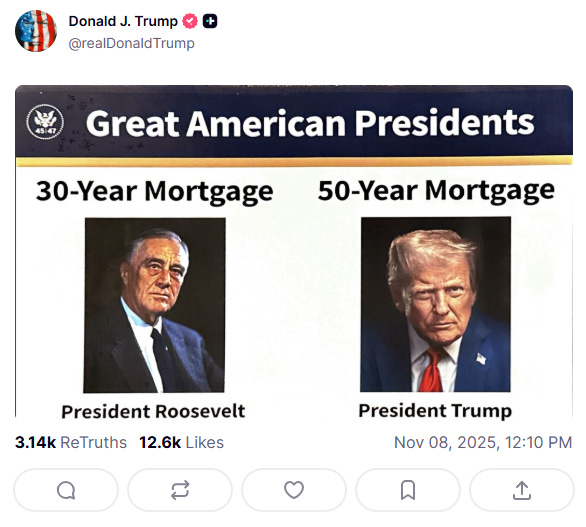
Flawed Critiques - The very first critique I saw asked, “Isn’t a 50 year mortgage effectively just renting a place from a bank?” Uh, no, it’s not. This is simple: renters don’t build equity; mortgage payers do. That’s the difference between a lease and an asset. Another common objection, “Banks will make more money on interest!” Well, yes, that’s literally how lending works. It doesn’t explain why the product is uniquely problematic, though. “People will die before paying off their homes!” Yet a 75-year-old can qualify for a 30-year fixed mortgage right now, and an 85-year-old with income can max out a 30-year HELOC with a 15-year draw period. The “dying with debt” critique is emotionally charged but irrelevant.
The Real Problem - Here’s the critique opponents should be making: 50-year mortgages are the new subprime. Not technically, but where it counts. Like subprime, the 50-year mortgage would slow equity growth, trap borrowers in place, and turn the promise of homeownership into a lifetime of debt. It’s a recent historical parallel that lands instantly, even for people who only vaguely remember the details—and it’s an honest parallel. A borrower 15 years into a 50-year loan has far less equity than someone 15 years into a 30-year, which means reduced mobility and greater vulnerability to market shocks or life changes. The traditional housing ladder—starter home, then bigger home, then downsizing and pocketing the capital—breaks. Borrowers may only buy two homes in a lifetime instead of three, stuck in place for decades. And like subprime, 50-year mortgages are marketed as expanding access but risk creating a class of lifelong debtors with no real leverage and no exit. All of this wraps neatly into an argument that clicks in an instant thanks to collective memory. Feel free to run with it.
Olympic Mental Gymnastics
The International Olympic Committee is expected to ban trans-women (read: men) from competing against (real) women in the 2028 Los Angeles Games. The committee was recently presented with scientific evidence showing physical advantages to being born male. For those of you shaking your heads, this is what happens when you outsource reality to “experts.” You can’t just accept what’s plainly observable. Even relying on what has always worked is treated as reckless. Rather, the obvious must be denied unless an expert can “verify” it. Until then, everyone must commit themselves to abject stupidity in the name of social consciousness.

This isn’t just about sports. Institutions have developed an outright bias against common sense. Observable reality is treated as suspicious, pending expert validation, like they expect it to have a twist. Worse, the experts are often just ideological proxies, selected for alignment instead of rigor. And when the public pushes back the response is gaslighting: instincts are bigoted and refusing to go along is “mean.” Anyway, this topic has already been beaten senseless, like a female boxer in an Olympic bout.
Woke Joke
This last one is just a little bugbear of mine, but James Lindsay added another trash bag to his “woke right” dumpster fire when he quote-tweeted Nalin Haley (Nikki’s son), who said:
“You’re not radical for wanting a job, affordable housing, and safe streets. You’re rational!”
Lindsay’s reply?
“Woke Right sounds like Woke Left from a decade ago.”

I’ll admit, I don’t know much about Nalin. But if this tweet is what passes for a “woke right” worldview, James has officially lost the plot. If you needed more proof that “woke right” is just a made-up boloney, look no further. James is now labeling kitchen table politics—the stuff of town hall meetings and union flyers for generations—as “woke.” The chef’s kiss? He dates the emergence of these concerns to ten years ago. As if moderates don’t care about jobs, housing, and safety.
Those are the stories that grabbed me this week, but I’m curious—what’s been on your radar? What did I overlook? Consider this an open thread.
Enjoying this very much, also forwarded it to my very-offline dad. Think the clarity of perspective and general lucidity may help some- he watches a lot of cable news, and the tone of that is... less measured and precise.